
2026 MID-YEAR MARKET REPORT
North Lake Tahoe & Truckee | First Half Review | January–June 2026
This Summer in Tahoe
By Ming Poon | SERHANT.
Data scope: Tahoe Sierra MLS core Tahoe-Truckee residential market only. Excludes Incline Village, Crystal Bay, Nevada, South Lake Tahoe, and out-of-area markets such as Sierra County, Plumas County, Graeagle, Loyalton, Sierraville, Floriston, and similar non-core areas. Lakefront figures refer to Lake Tahoe lakefront and lakefront condo/PUD transactions within the Tahoe Sierra MLS footprint.
By early July, Tahoe and Truckee are fully into their summer rhythm. The lake is busy again, trails are open, golf courses are in full swing, and the long evenings make it easy to remember why people continue to build their lives around this place. A morning ride, an afternoon on the water, and dinner outside can all happen in the same day. That lifestyle is not a footnote to the market; it is the foundation of demand.
The first half of 2026 reinforced that point. Buyers remained active, inventory returned in a meaningful way, and luxury continued to shape total dollar volume. At the same time, the market became more selective. Price, condition, neighborhood, setting, and presentation matter more today than they did during the most constrained years of the post-pandemic market.
The most useful way to read the first half is not as a simple story of strength or softness. It is a story of normalization. Activity is stronger than a year ago. Supply has improved. The top of the market remains highly capable of producing significant sales. But buyers are no longer treating every listing as urgent. They have more choice, more information, and a greater willingness to wait for the right property.
FIRST HALF REVIEW
By the Numbers
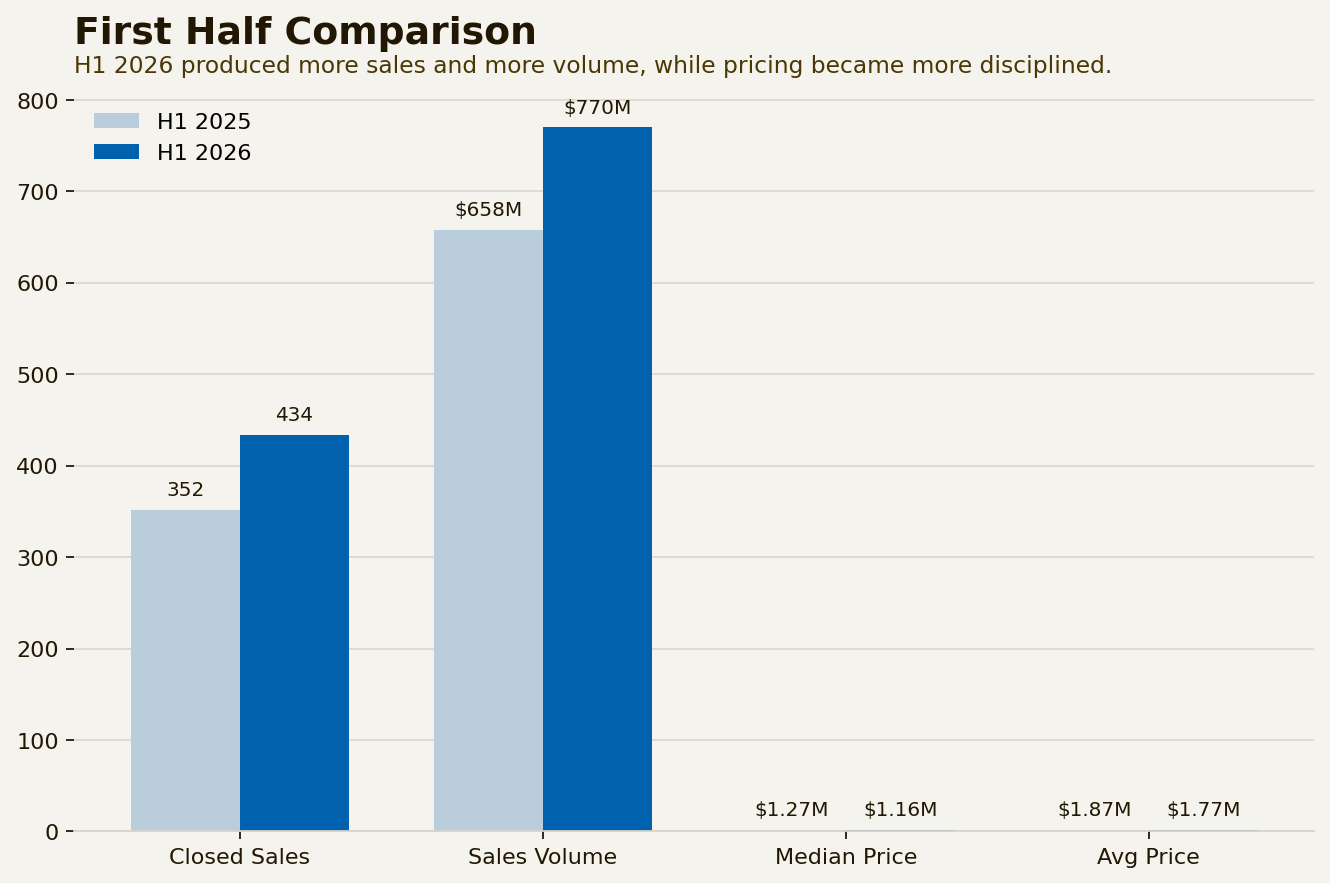
First-half closed sales increased from 352 in 2025 to 434 in 2026, a +23% increase. Total dollar volume rose from $658.1M to $770.0M, up +17%. Median price declined from $1.275M to $1.163M, while average price declined from $1.87M to $1.77M.
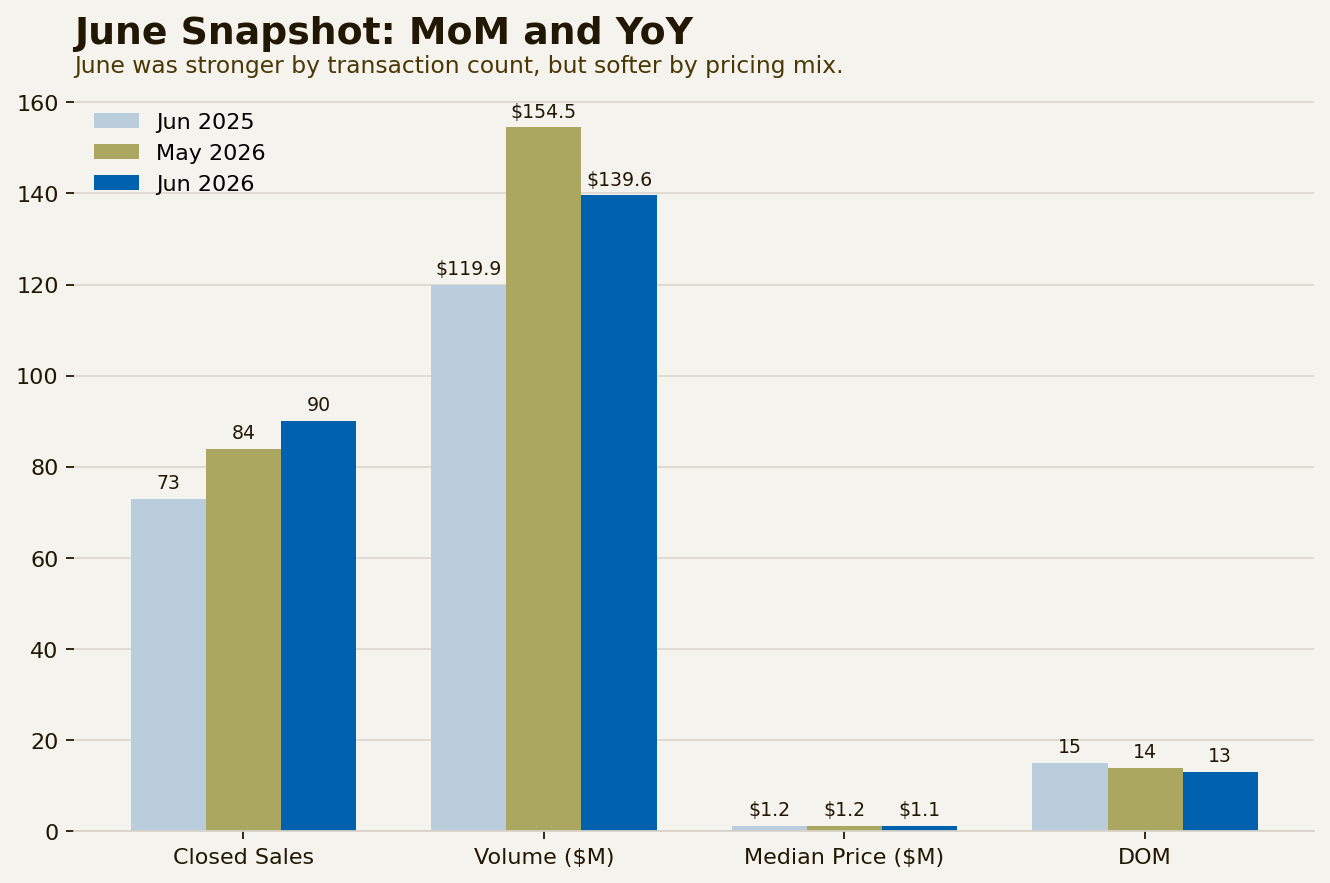
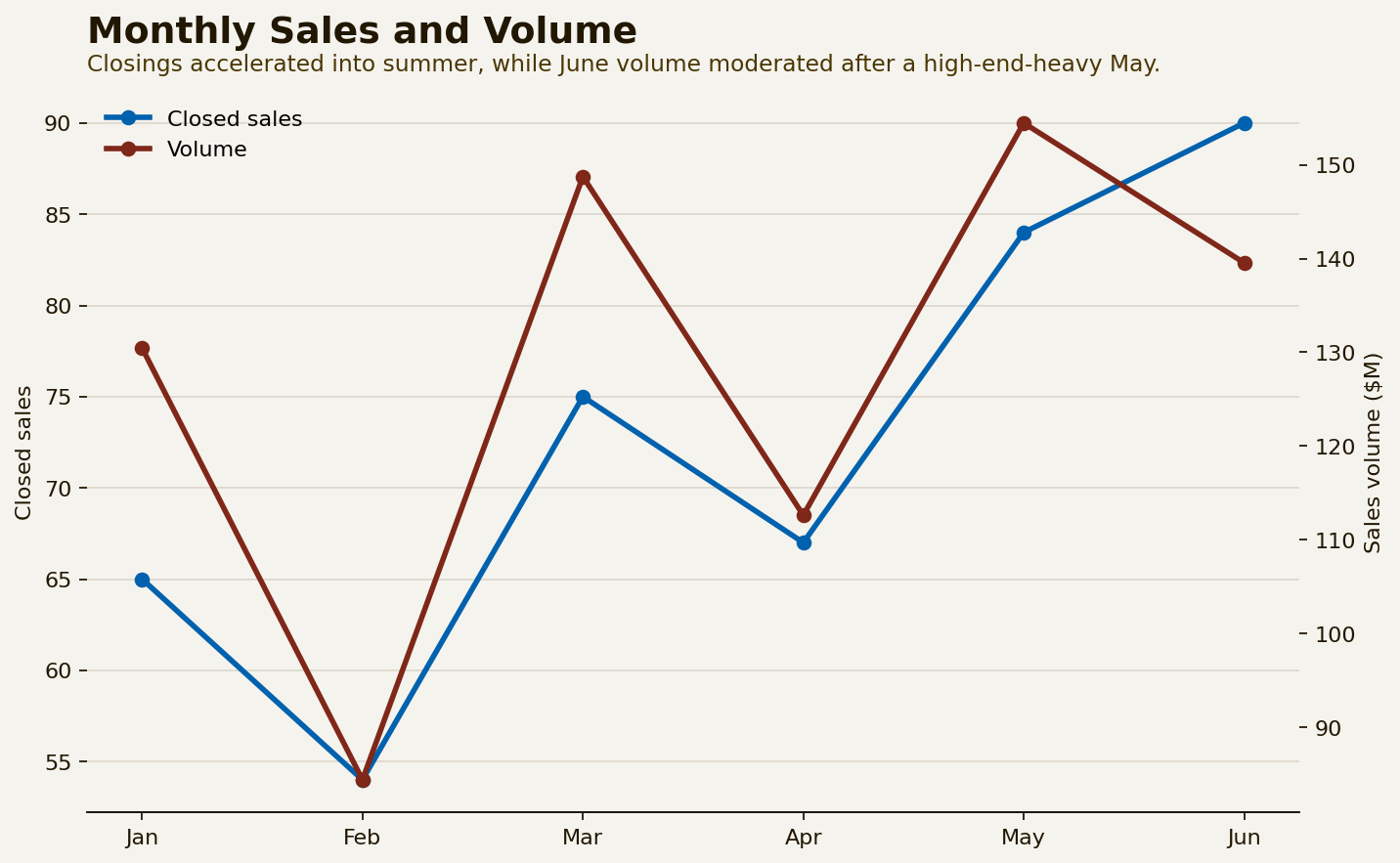
June also continued the summer build. Closed sales increased from 84 in May to 90 in June. Active listings increased from 361 to 424, while pending and contingent activity increased from 107 to 115. That combination matters: supply expanded, but demand did not disappear.
MARKET TAKEAWAYS
Five Things the First Half Tells Us
1. Inventory is returning, and that is healthy.
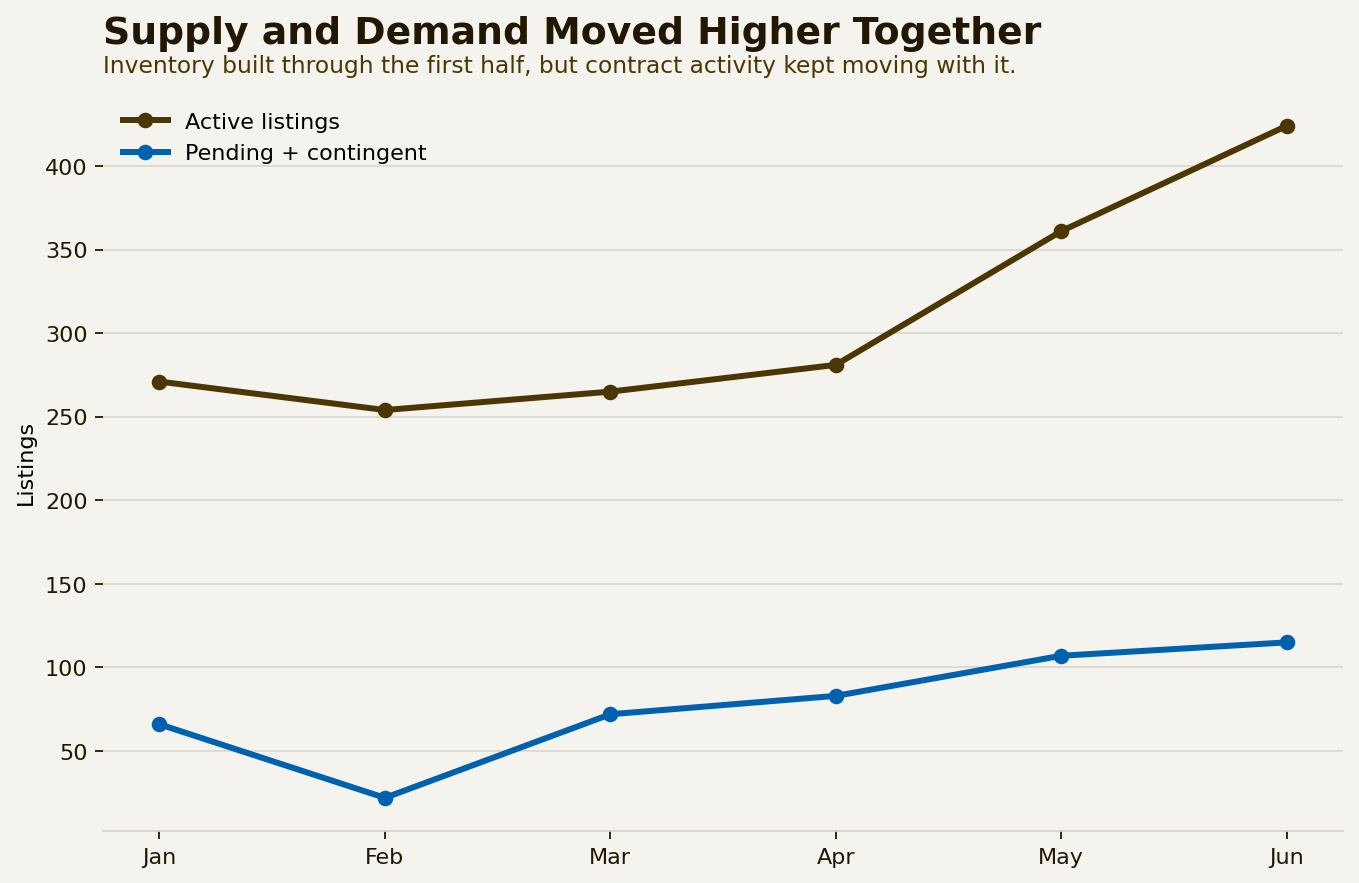
After several years in which buyers had limited options, inventory has finally moved meaningfully higher. Active listings rose from 271 in January to 424 in June. The most notable shift came in May and June, when the market moved into peak selling season and new supply arrived quickly.
More inventory does not automatically mean a weaker market. In the Tahoe-Truckee context, more supply can also mean the market is functioning better. Buyers have more properties to compare. Sellers have more competition. Negotiations become more rational. The intensity of the 2020-2022 market has faded, but that does not mean demand has disappeared. It means the market is becoming more balanced.
Bottom line: inventory is no longer the constraint it was, but quality inventory remains limited in the best locations.
2. Demand remains active, but more selective.
The most important demand-side signal is that pending and contingent activity continued to rise as inventory expanded. Pending and contingent listings increased from 107 in May to 115 in June. Closed sales also improved, rising to 90 in June, the strongest monthly count of the year so far.
That said, buyer behavior has changed. Buyers are still writing offers, but they are more selective about condition, pricing, insurance, HOA dues, remodel costs, and long-term usability. The best properties continue to draw attention quickly. Properties that miss the mark on pricing or presentation are more exposed than they would have been during the height of the inventory shortage.
Bottom line: demand is present, but it is rewarding accuracy and punishing overreach.
3. Pricing is not moving uniformly higher.
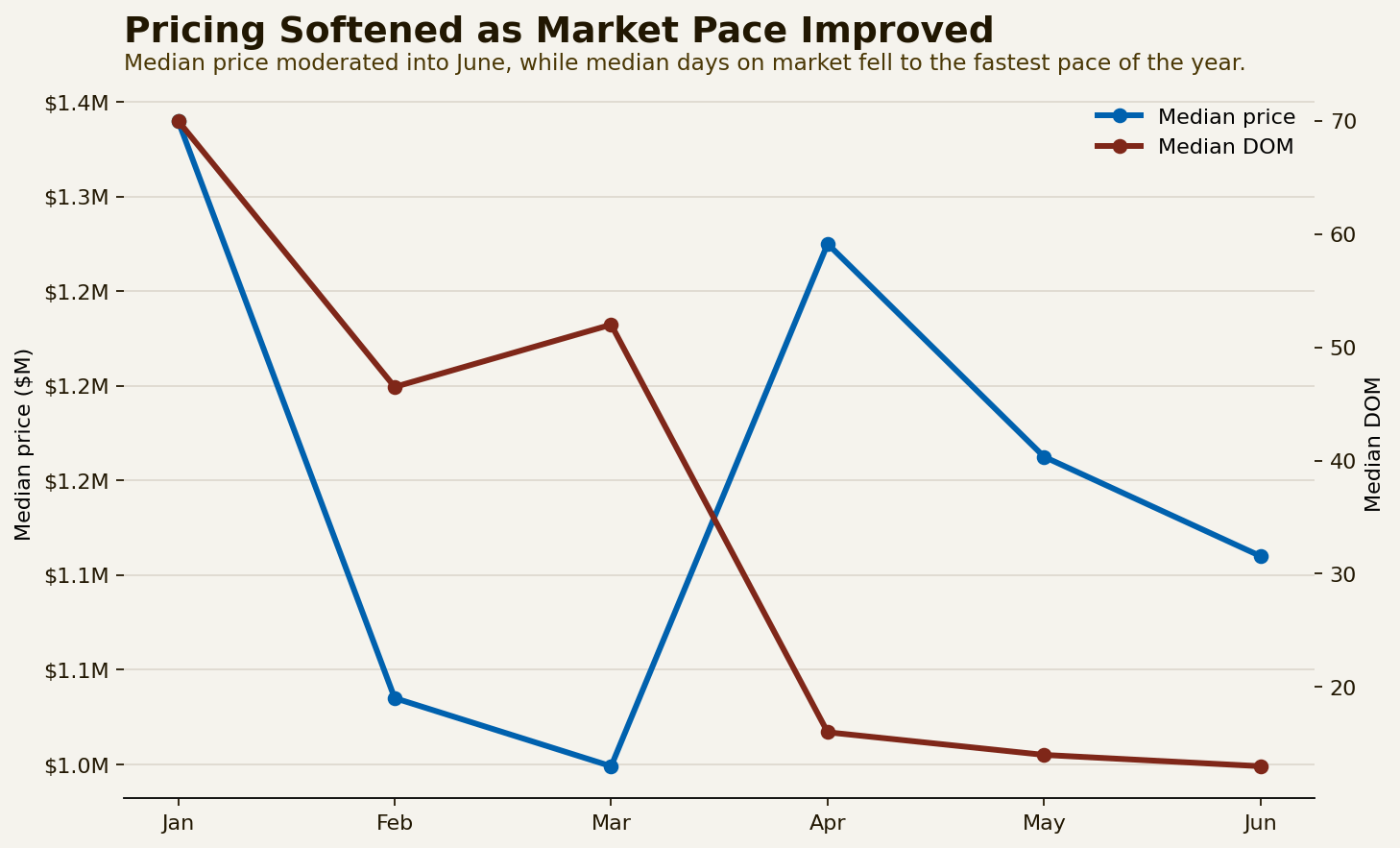
The first-half pricing story is nuanced. Total sales and total volume both increased year over year, but median and average price declined. Median price moved from $1.275M in the first half of 2025 to $1.163M in the first half of 2026. Average price moved from $1.87M to $1.77M.
That does not necessarily indicate broad value erosion. It reflects a more active market across a wider range of price points and a less concentrated mix of ultra-high-end closings compared with certain prior periods. In June, for example, closed sales increased, but dollar volume declined from May because the transaction mix shifted away from May's heavier concentration of trophy sales.
This is the type of market where broad averages can be misleading. A turnkey home near recreation, a dated home with deferred maintenance, a lakefront estate, and a condo with high dues are all behaving differently. Micro-market analysis matters more now than a single market-wide price statistic.
Bottom line: values are not moving in one direction across the board; the market is sorting itself by property quality, location, and buyer conviction.
4. Luxury continues to shape the market.
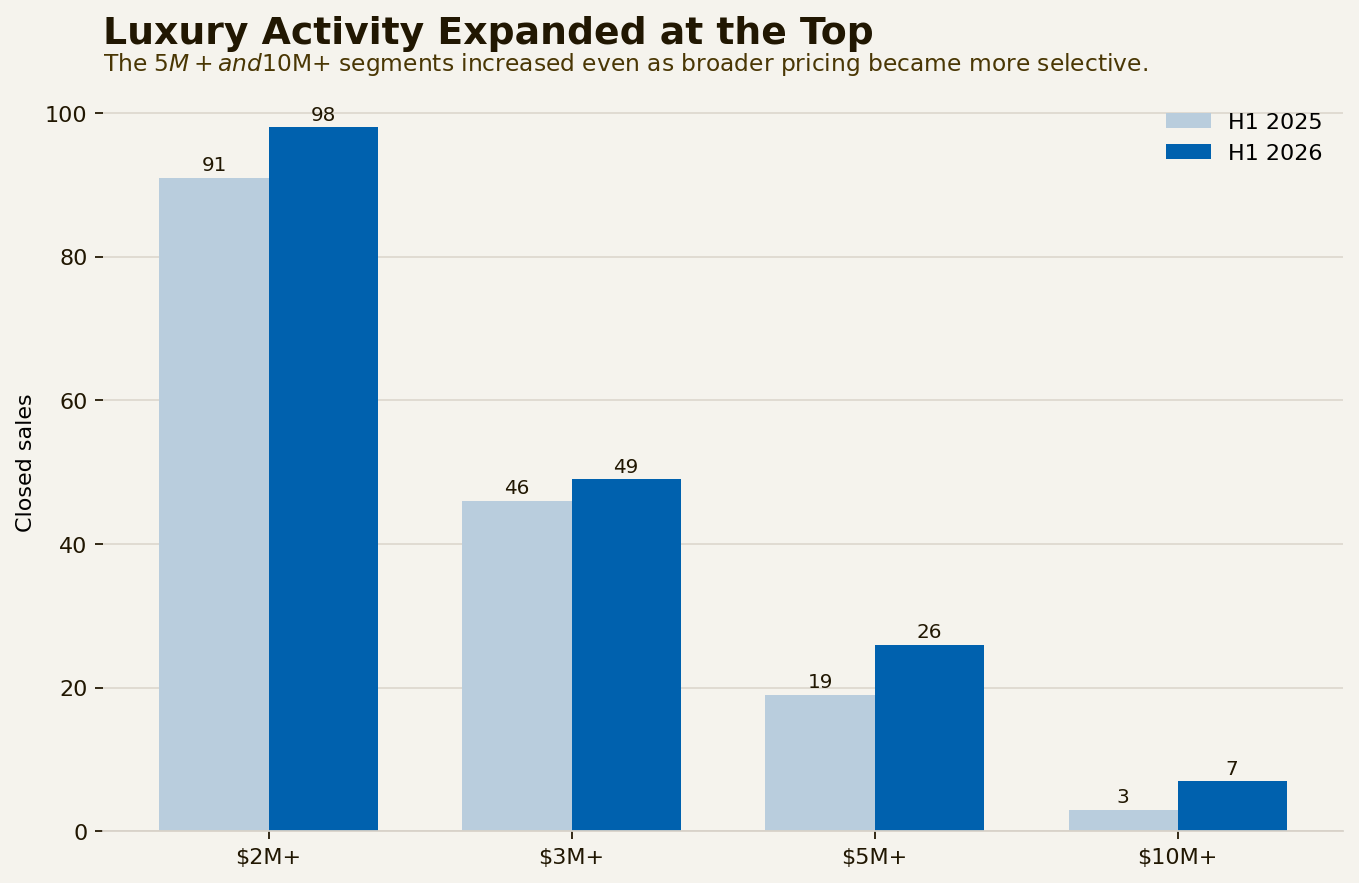
The luxury segment remains one of the defining stories of 2026. Sales above $5M increased from 19 in the first half of 2025 to 26 in the first half of 2026. Sales above $10M increased from 3 to 7. Even as broader pricing became more disciplined, the top of the market continued to transact.
The luxury buyer behaves differently from the rate-sensitive mid-market buyer. At the upper end, decisions are often driven by scarcity, privacy, architecture, setting, legacy ownership, and long-term positioning rather than short-term financing conditions. That does not mean luxury buyers are careless. They are often highly selective. But when the asset is rare enough, capital continues to move.
Truckee played a major role in that story. Martis Camp, Lahontan, Schaffer's Mill, Gray's Crossing, Northstar, and Donner Lake continue to attract buyers who want access to year-round recreation with privacy, amenities, and newer mountain architecture.
Bottom line: the high end remains resilient, but buyers are focusing on the properties that feel truly differentiated.
5. Lakefront remains its own market.
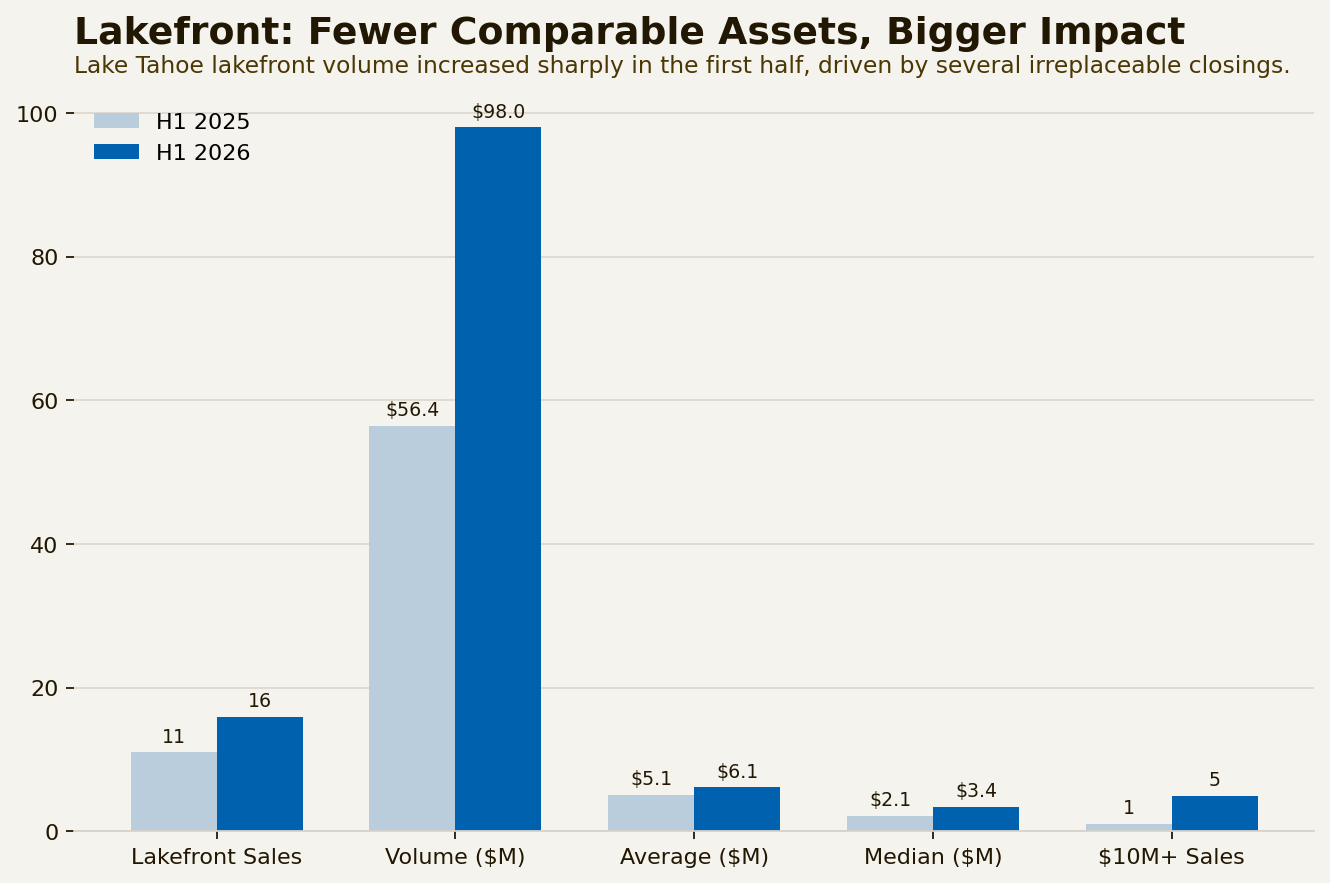
Lakefront activity deserves separate treatment because it does not behave like the broader market. In the first half of 2026, Lake Tahoe lakefront and lakefront condo/PUD sales within the Tahoe Sierra MLS core market totaled 16 transactions and approximately $98.0M in volume. That compares with 11 transactions and approximately $56.4M during the first half of 2025.
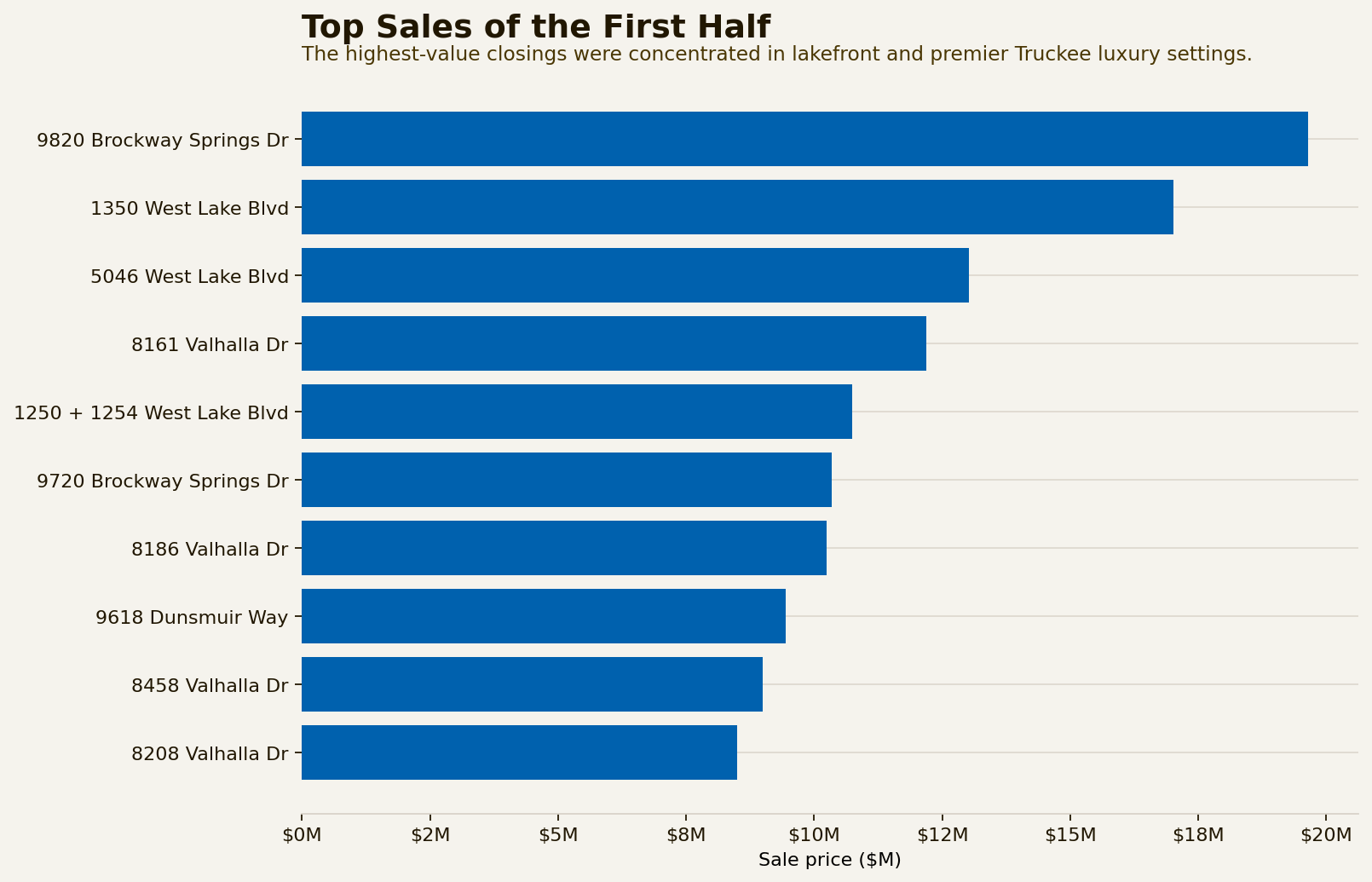
Several first-half transactions reinforced the depth of demand for irreplaceable lakefront assets, including 9820 Brockway Springs Drive at $19.65M, 1350 West Lake Boulevard at $17.01M, 5046 West Lake Boulevard at $13.013M, 1250 + 1254 West Lake Boulevard at $10.75M, and 9720 Brockway Springs Drive at $10.35M.
Lakefront ownership is defined by scarcity. The number of true lakefront opportunities is limited, and many properties rarely trade. As a result, lakefront pricing is often driven less by broad market conditions and more by the specific quality of the asset: frontage, pier and buoy rights, privacy, architecture, sun exposure, proximity to town, and the rarity of the setting.
Bottom line: lakefront is not simply a luxury segment; it is a scarcity market.

COMMUNITY FOCUS
Truckee Spotlight
Truckee continues to be central to the Tahoe Sierra MLS story. In June, Truckee accounted for a large share of closed sales and dollar volume, and many of the most significant non-lakefront luxury transactions occurred in Truckee-area communities. That is not surprising. Truckee offers a wide range of property types, from Tahoe Donner cabins and Donner Lake homes to Martis Camp estates, Northstar ski properties, and private golf communities.
The important point is that Truckee is not one market. Tahoe Donner, Donner Lake, Gray's Crossing, Lahontan, Martis Camp, Schaffer's Mill, Old Greenwood, Northstar, and Olympic Valley each attract different buyers and carry different pricing dynamics. Some buyers prioritize amenities and privacy. Others prioritize walkability, rental potential, ski access, golf, or proximity to town.
This segmentation is why a market-wide median price is not enough. A strong result in Martis Camp does not automatically reset values in Tahoe Donner. A slower-moving mid-market listing does not mean demand has disappeared in Northstar or Gray's Crossing. The market is becoming more specific, not less active.
Bottom line: Truckee remains one of the most important engines of the broader Tahoe Sierra MLS market, but performance varies sharply by community and property type.

MARKET CONTEXT
What the Data Tells Us
The first half of 2026 points to a market that is healthier than it was a year ago, but also more discerning. Transaction volume improved. Dollar volume improved. Inventory increased. Pending activity remained solid. Luxury continued to produce meaningful transactions. Those are constructive signals.
At the same time, the market is no longer defined by universal urgency. Buyers have more leverage than they had when inventory was extremely constrained. They are more willing to compare options and less willing to overlook deferred maintenance, poor presentation, or ambitious pricing. Sellers still have an audience, but they need to compete more thoughtfully.
The clearest conclusion is that the market is moving toward balance. That does not mean equal power in every segment. Lakefront and premier luxury remain supply constrained. Well-priced homes in desirable locations can still move quickly. But the broader market is no longer operating as if every listing is scarce. More listings are available, and buyers are responding with greater discipline.
This is a better environment for thoughtful decision-making. Buyers can be more strategic. Sellers can still succeed, but preparation matters more. Advisors have to be more precise because the market is no longer doing all the work.
LOOKING AHEAD
Second-Half Outlook
The second half of the year will likely be shaped by three forces: inventory, buyer confidence, and the concentration of luxury demand.
Inventory will be the first variable to watch. If active listings continue to rise through July and August while pending activity remains steady, the market should continue moving toward balance rather than weakness. If pending activity stalls while inventory continues rising, buyers may gain additional leverage in certain segments.
Buyer confidence is the second variable. Interest rates, stock market performance, insurance availability, and broader economic sentiment all matter, especially in the $1M to $3M range where financing and cost of ownership play a larger role. A modest improvement in rates could quickly bring additional buyers back into the market. Conversely, rate volatility could keep buyers selective.
Luxury is the third variable. The upper end has remained active, but luxury buyers are still selective. The best properties will continue to draw capital, but the market is unlikely to reward every high-end listing equally. Scarcity, architecture, setting, and presentation will determine outcomes.
The most likely path is not a sharp correction or a return to pandemic-era acceleration. It is a more normal summer market: active, competitive, more balanced, and increasingly segmented.
WATCH LIST
What We'll Be Watching
Inventory growth: Active listings increased meaningfully through the first half. The key question is whether inventory continues to build into late summer or begins to level off as buyers absorb new supply.
Pending activity: Pending and contingent listings are one of the clearest leading indicators of buyer demand. If contract activity remains healthy while inventory rises, it would reinforce the case for a balanced market rather than a weakening one.
Luxury demand: Sales above $5M and $10M increased year over year during the first half. Continued activity at the top would support total dollar volume even if the middle of the market remains more price sensitive.
Pricing discipline: As inventory increases, the gap between well-positioned listings and aspirationally priced listings should widen. Price reductions and days on market will be important indicators in the months ahead.
Insurance and cost of ownership: Insurance availability, HOA dues, maintenance costs, and remodel costs are increasingly part of buyer underwriting. These factors may influence demand most clearly in the middle of the market.
CLOSING THOUGHT
The View From Here
The best part of summer in Tahoe is that it makes the value proposition obvious. You do not have to explain it. You can see it in the trailheads, on the lake, at the golf courses, in town, and in the long evenings when the light seems to linger over the mountains longer than it should.
That is why the market continues to matter beyond the numbers. People are not only buying real estate here. They are buying access to a way of living: more time outside, more time with family, more proximity to the places and activities that shape their days. The data changes every month. The lifestyle that underpins long-term demand is much more durable.
As we move into the second half of the year, the market is giving both buyers and sellers more to think about. Buyers have more choice. Sellers still have demand, but they need to be sharper. The best decisions will come from understanding not only what the broad market is doing, but which segment of the market applies to you.
Until next time, enjoy Tahoe.
— Ming

Ming Poon
SERHANT.