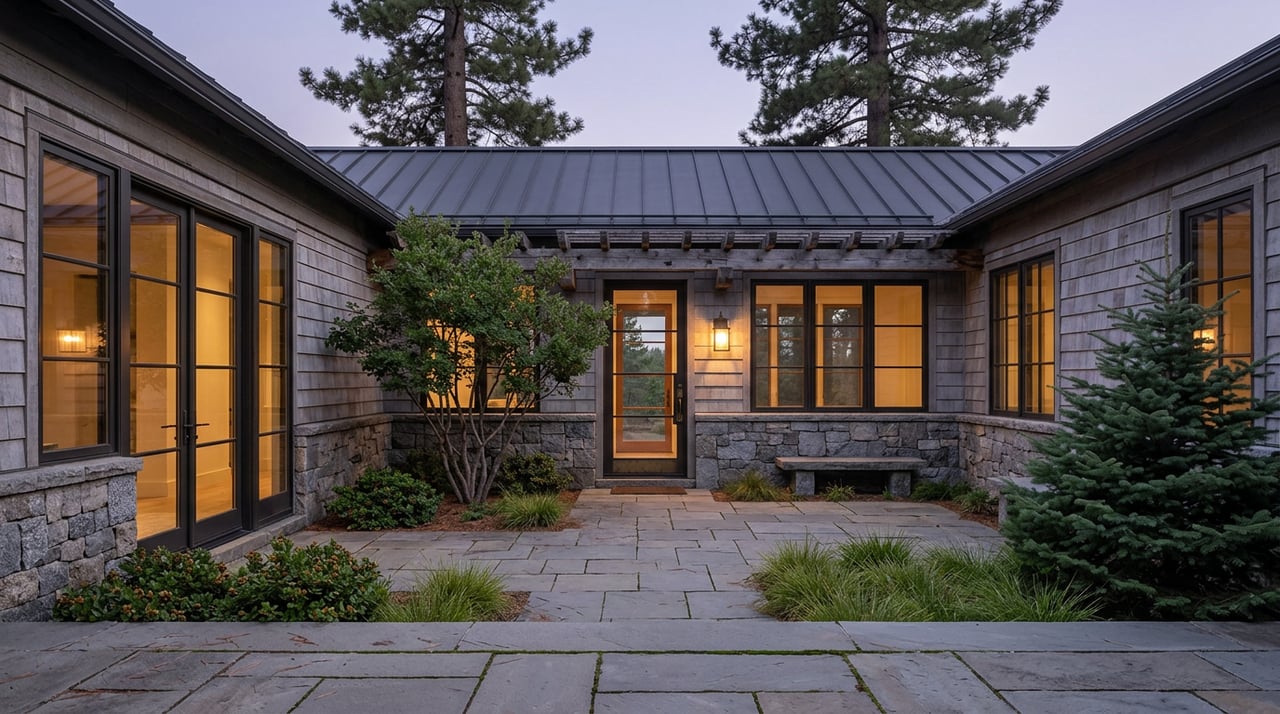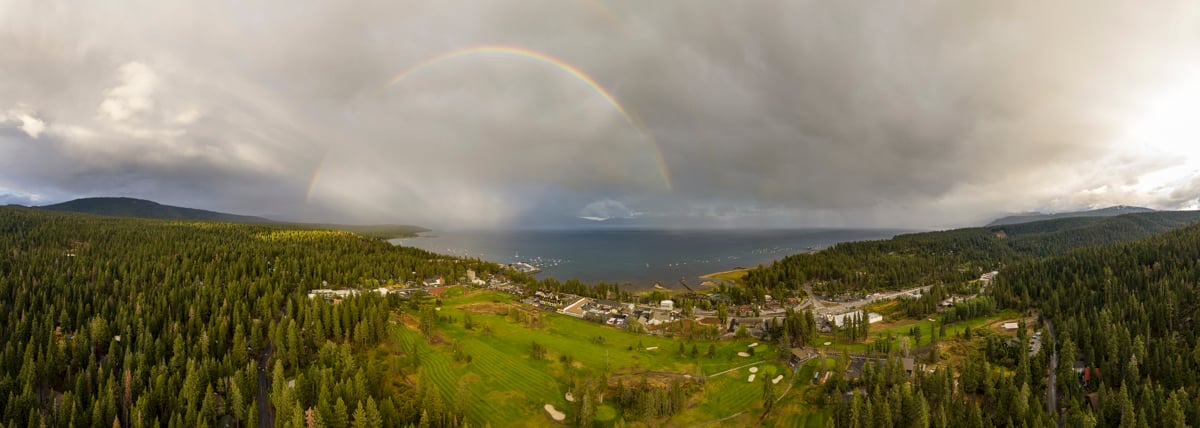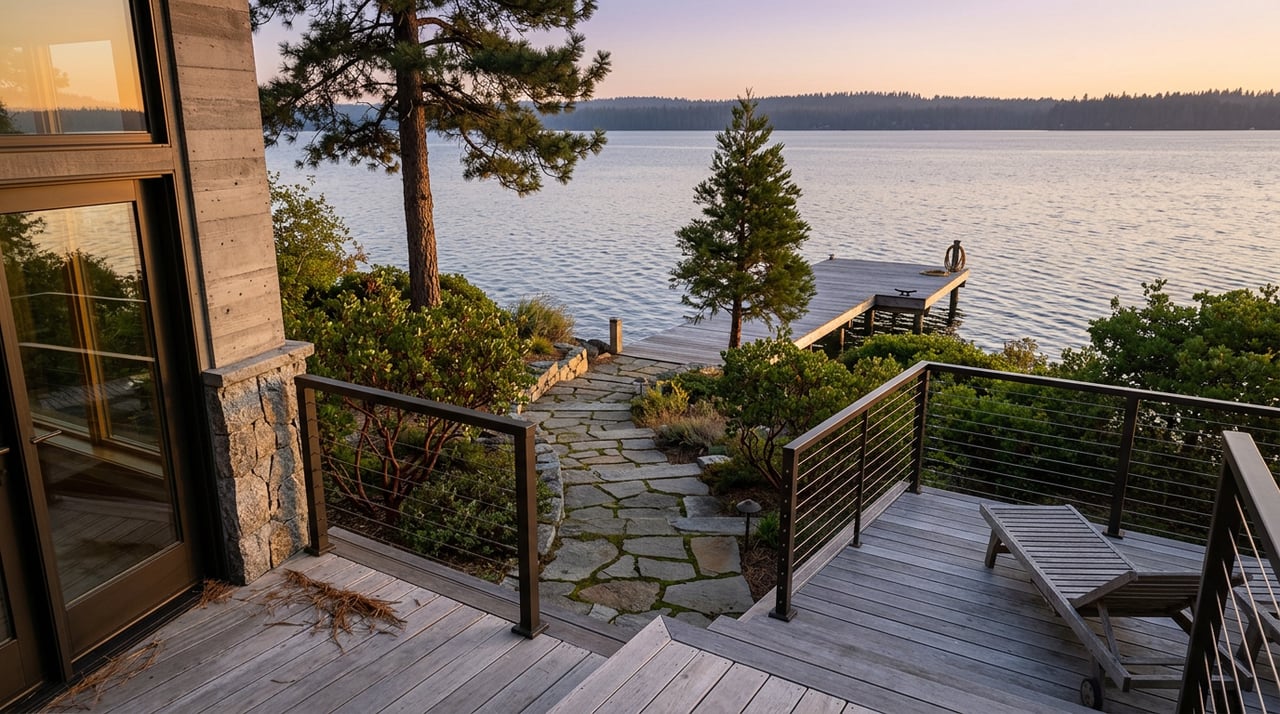
Two homes go under contract in Tahoe City the same week, both around three million dollars, both roughly 3,000 square feet, both with a deck and a view worth bragging about. A year later, one owner is framing out a primary suite addition. The other is stuck. Same price bracket, same neighborhood, completely different futures, and the difference had nothing to do with the sale price. It came down to a number that almost never shows up in the listing photos: how much of that lot is legally allowed to be covered by a structure at all.
In most of the country, what you can build on a property is mostly a function of zoning setbacks and your imagination. In the Tahoe Basin, it's a function of a regulatory ceiling set decades ago, measured in square feet, and administered by an agency most buyers have never heard of until they try to add a garage.
The Number That Isn't on the Listing
The Tahoe Regional Planning Agency, known locally as TRPA, caps how much of a parcel can be covered by anything impervious: the house, the driveway, the deck, the parking pad. That cap exists because impervious surface is the single biggest driver of the runoff that clouds Lake Tahoe's water, and the agency has spent decades trying to hold the line on it.
Two separate systems determine how much coverage a given Tahoe City parcel actually has. Homes built and developed before July 1, 1987 fall under something called the Bailey system, a land capability rating tied to soil maps from the early 1970s. Anything developed from 1987 forward, and any vacant parcel evaluated since then, falls under the Individual Parcel Evaluation System, or IPES, which assigns every vacant residential parcel a numeric score from 0 to 1017 based on a physical inspection of the soil and site.
That score is the ceiling. It's not printed on the MLS sheet. It doesn't move the appraisal. But it decides whether the home you're buying can ever get bigger.
How a Score Becomes a Ceiling
The IPES score isn't a single measurement. TRPA field teams, a soils scientist, a hydrologist, and a planner or engineer working together, walk vacant parcels and score them across eight factors: erosion hazard, runoff potential, site access, proximity to stream environment zones, condition of the surrounding watershed, the land's ability to revegetate, the need for water quality improvements nearby, and distance from the lake itself.
- A parcel scores somewhere between 0 and 1017.
- In Placer County, where Tahoe City sits, the original 1987 buildable line was set at 726. It has since edged down to 691, the current cutoff.
- Score below that line, and the parcel isn't automatically eligible. The owner has to apply for an allocation instead.
- Base allowable coverage is then calculated from three of those same eight factors, mainly erosion hazard and runoff potential, which means two parcels with identical IPES scores can still end up with different coverage percentages.
- If the parcel is larger than a third of an acre, only that first 14,520 square feet gets evaluated initially. Anything beyond it needs a separate Determination of Allowable Coverage before TRPA will treat the rest of the lot as buildable.
TRPA's own coverage ordinance walks through the base math this way: a five-acre parcel works out to 217,800 square feet, and at a 30 percent base allowable coverage rate, that's 65,340 square feet of coverage available before an owner needs to look at a transfer. It's a clean illustration of the formula, but the actual percentage a given Tahoe City lot receives depends entirely on its own site conditions, not a flat rule that applies basin-wide.
Here's the part that catches buyers off guard: coverage doesn't travel freely between parcels either. A transfer generally has to come from within the same hydrologically related area, meaning an owner sitting on unused coverage two neighborhoods over usually can't sell it to a buyer on the other side of Tahoe City. For decades, that restriction has quietly frozen expansion potential in specific pockets of the basin while leaving other pockets with coverage to spare.
Why Placer County's Line Sits Far Above Everyone Else's
TRPA designed IPES in the late 1980s expecting the buildable line to drop over time in every jurisdiction, opening more parcels to development as each county demonstrated environmental progress. In several counties, that's exactly what happened. El Dorado County, Washoe County, Douglas County, and the City of South Lake Tahoe have all lowered their eligibility lines to the point where any parcel with a score above zero can apply for an allocation, because the ratio of non-sensitive vacant land to sensitive vacant land in those counties has grown enough to justify it.
Placer County has moved too, just barely. The line has edged down from 726 to 691 over roughly four decades, according to TRPA's own current figures, while its neighbors opened almost entirely. TRPA has said plainly that the ratio of non-sensitive to sensitive vacant parcels in Placer County has never reached the threshold that let other counties open further.
That gap is now formally on the table. On March 25, 2026, the TRPA Governing Board's meeting agenda carried a consent item titled "Lowering the Placer County Individual Parcel Evaluation System (IPES) Buildable Line," putting the one number that has shaped Tahoe City's buildable inventory since 1987 up for direct reconsideration.
That item sits inside a much larger process. TRPA has spent more than two years working through a multi-year policy update called Cultivating Community, Conserving the Basin, aimed at aligning housing rules, including coverage, with the basin's environmental limits. On January 28, 2026, the Governing Board voted on which of those housing policy ideas would move forward into formal environmental review, and that same day TRPA issued a Notice of Preparation, opening a six-week public comment period on what the resulting Environmental Impact Statement should study.
A rough timeline of how this has moved:
- October 15, 2025 — TRPA staff present draft policy recommendations to the Governing Board, including options around multi-family coverage rules and small accessory dwelling units.
- November 19, 2025 — The Governing Board reviews those draft recommendations and gives direction on which ideas to prioritize.
- January 28, 2026 — The Governing Board votes on the final slate of housing policies to analyze, including coverage-related options.
- January 29, 2026 — TRPA opens a six-week public comment period on the scope of the Environmental Impact Statement.
- February 11, 2026 — The Advisory Planning Commission weighs in on the EIS scope.
- March 25, 2026 — A separate item lowering the Placer County IPES buildable line appears on the Governing Board's agenda.
- Fall 2026 — A draft Environmental Impact Statement is expected for public comment.
- Early 2027 — The Governing Board is expected to vote on the final policy package.
None of this is settled. But a buyer or seller who assumes the coverage rules on a Tahoe City parcel today will still look the same by the time the Governing Board votes in early 2027 is making a bet the agency itself is actively reconsidering.
Pre-1987 or Not: What a Buyer Should Actually Ask
| Built or Developed Before July 1, 1987 (Bailey) | Vacant Parcel or Post-1987 Redevelopment (IPES) | |
|---|---|---|
| Does it have a score? | No IPES score needed | Scored 0-1017 by a TRPA field team |
| What sets the coverage ceiling? | Existing coverage on file with TRPA at time of construction | Score relative to Placer County's current buildable line |
| What to verify before closing | Whether existing coverage was ever formally verified with TRPA | Whether the parcel clears the buildable line, or would need an allocation or a coverage transfer |
| Biggest risk | Assuming existing footprint has room to expand without checking the file | Assuming a below-the-line lot is a straightforward buildable site |
For a buyer picturing a bigger primary suite, a garage, or a larger deck, the honest first question isn't the sale price. It's whether the parcel has coverage left to give, and whether that coverage can legally get to where the addition needs to go.
What This Means for a Seller Sitting on Room to Grow
If a Tahoe City property has unused coverage relative to its size and IPES rating, that's a real asset, separate from square footage and separate from the view. It's the difference between a buyer who can renovate freely and one who's boxed in from day one, and it's worth documenting the same way an owner would document a recent roof or a clean title. A seller who can hand a buyer a clear answer on coverage, rather than a shrug, is removing one of the few frictions in a Tahoe transaction that can't be solved with a faster escrow or a better inspector.
A Few Straight Answers
What is an IPES score, in plain terms? It's a numeric rating TRPA assigns to vacant residential parcels in the Tahoe Basin, based on soil, slope, and proximity to sensitive land, that determines whether the parcel is eligible for a building allocation and how much coverage it can support.
Does every home in Tahoe City have one? No. Homes developed before July 1, 1987 fall under the older Bailey system instead and don't need an IPES score at all.
Can I just buy more coverage if I run out? Sometimes, but transfers are generally restricted to parcels within the same hydrologically related area, so it isn't as simple as purchasing coverage from anywhere in the basin.
Is the Placer County buildable line actually going to change? A specific proposal to lower it reached the TRPA Governing Board's agenda on March 25, 2026, and it sits alongside a broader multi-year policy review that isn't expected to reach a final vote until early 2027.
Land coverage in Tahoe City rewards the buyer and seller who ask the right question before the offer, not after the remodel plans come back denied. Ming Poon works both sides of that conversation daily, across California and Nevada MLS systems, with the kind of parcel-level detail that turns a coverage report into a clear plan instead of a surprise. Let's Connect.